

|
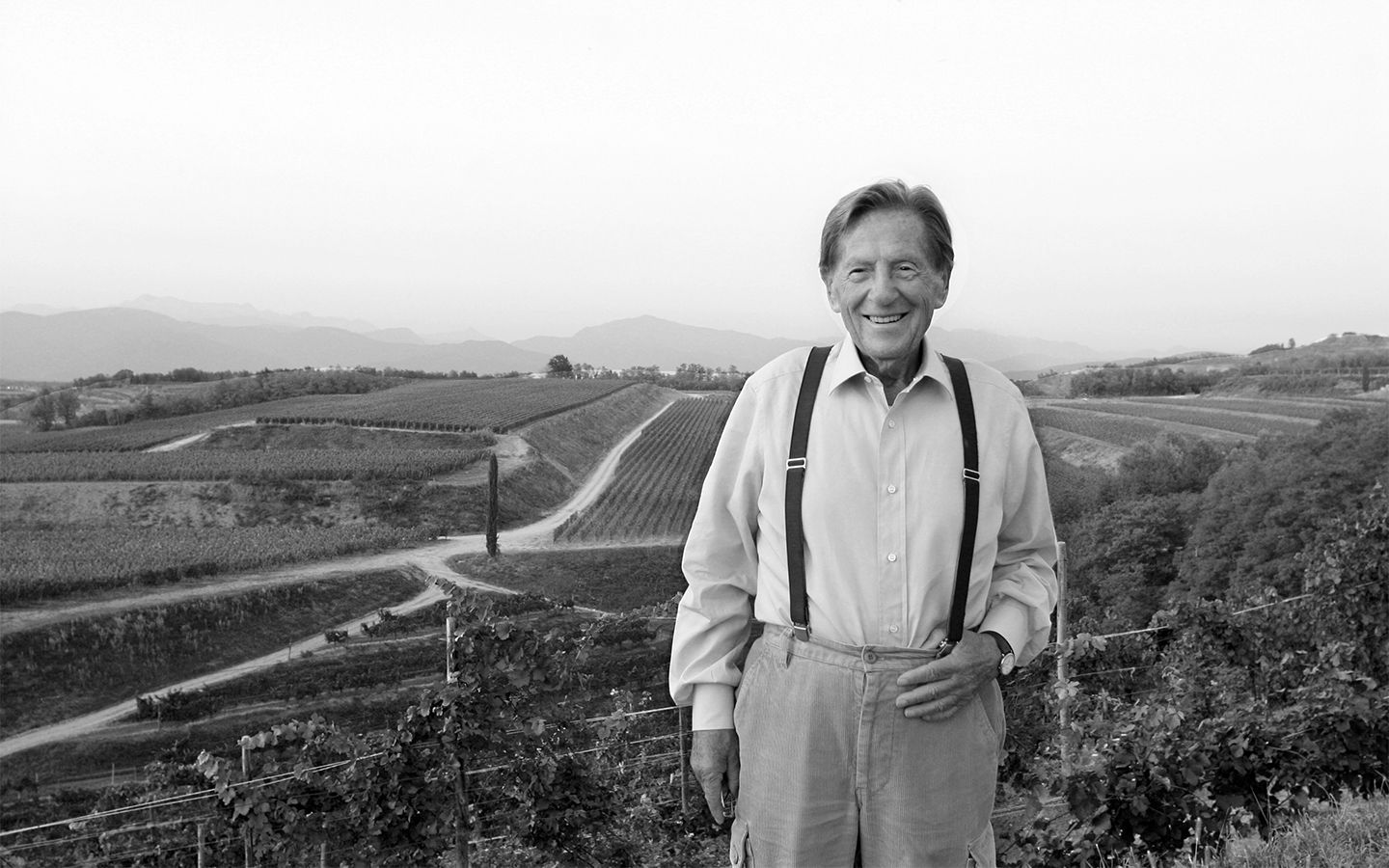
Livio FellugaDeepeningsLAUDATION FOR THE HONORARY DEGREE AWARDED TO LIVIO FELLUGA![]() An honorary degree is the culmination of a profound process of reflection on the part of the university concerned. It is the highest award that any university can bestow on those whose skills and profusion of personal ideas, wherever applied, have provided a beacon for the entire community. A degree of this kind is, therefore, more than a mere acknowledgement because it represents the collegiate, convinced decision of a faculty’s teaching staff which, leaving to one side distinctions of academic discipline, identifies itself with the recipient. For this reason, the award of the honorary inter-university specialist degree in viticulture, oenology and wine markets to Livio Felluga is a moment of great joy for the faculty of agriculture at this university and its associated universities of Padua and Verona. Livio Felluga is a leading figure on the regional, Italian and international wine scene but above all, he is a man with strong ties to the land, a man who perceived and developed the wine potential of Friuli, giving it international visibility and esteem. Livio Felluga can justly be regarded as one of the fathers of Italy’s post-war wine renaissance at a time when the vine-clad hills were losing population. Hill farmers were drifting away because their earnings were so low that they preferred to take factory jobs or emigrate. Felluga set an example, showing that hillslope viticulture can be profitable, provided you make wine to consistently high quality standards that improve over time. He showed that wine estates were economically viable in a period when it was the general opinion that the economies of scale achievable by co-operative wineries were the only way forward for Italian wine. There is irrefutable evidence that vines were cultivated by the Sumerians in southern Mesopotamia, on the flatlands between the Tigris and the Euphrates, at the beginning of the third millennium BC. It is impossible to pinpoint the precise moment of history when wine was first made but it is mentioned in documents that have come down to us from this period. As is clear from the code of Hammurabi, which dates from around 1700 BC, the most important beverage in the Babylonian economy was beer. Nevertheless, wine was essential for various religious ceremonies and was consumed by the ruling elite. The foundation of the Benedictine order brought European viticulture out of the crisis into which it had plunged after the fall of the Roman empire. Vines were cultivated once again thanks to the protection provided by the Franks. The monks’ motto “ora et labora” (pray and work) encouraged the recovery of abandoned fields, the clearing of woods and the draining of marshland, along with selection of the vines that gave the best grapes. Vineyards contained semi-wild vines picked in the woods and plants that were brought from the east, as well of course as their spontaneous crossings. In April 1112, a young man determined to change the rules of medieval monasticism appeared in the Saône valley. His name was Bernard de Fontaine and he founded the Cistercian order. At the age of twenty-one, Bernard headed the group of thirty well-born youngsters who entered the small, newly founded monastery at Cîteaux, just north of Baume. It was a modest farm in the woods of Burgundy but Bernard was not afraid of hard work and sacrifice. The Cistercian order was organised in great detail and the rules decreed that when the community grew to sixty monks, twelve should leave to found a new monastery. The first of those communities sprang up in Burgundy. Others followed in France and then in the rest of Europe. By the time that Bernard died, his order embraced more than four hundred abbeys. Unsurprisingly, viticulture was one of the Cistercian order’s main activities. The monks had found an occupation where they could give free rein to their obsessive attention to detail. As we have noted, destiny brought the Cistercians to superb wine country, such as many parts of Burgundy, including Chablis, and Champagne. This gave them the opportunity to compare a huge number of wines from a wide range of sources, produced using different vinification techniques. When the monks replanted a vineyard, or planted a new one, they made a painstaking study of the most appropriate vines, they experimented with different pruning systems, they took cuttings and they tested grafts. The grapes would be vinified with the utmost care as they constantly refined their tastes. Over the centuries, the order created what was in effect a database that can justly be regarded as the foundation for France’s crus, an approach that has left an indelible mark on world winemaking. During the Renaissance, the Bordeaux region underwent a long period of improvement and development, both in vineyard management and in the production techniques employed by generations of growers to cater for a highly demanding international and domestic market. What set Bordeaux apart from other wine areas was demand from wealthy English aristocrats whose considerable economic power enabled them to insist on the very finest quality. The identification of the word château with wine estate in Bordeaux is said to date from the mid 16th century, when Jean de Pontac, who came from a rich, influential family of Bordeaux parliamentarians, settled on a wine property at Haut-Brion near Bordeaux, “where the new lord deemed it necessary to build a castle to embody his absolute power”. This was also the period into which Fabio Asquini, count of Fagagna, was born. On his estate in his native town, Asquini conducted the experiments that led to the creation of a unique wine, Picolit. There can be no doubt that it was a superior-quality wine but the most striking thing about Picolit is what we would today call the count’s marketing plan, a strategy that decreed the astonishing success of his wine. The count quickly found himself having to deal with imitations and swindlers who attempted to pass off other wines as Picolit from Fagagna. He appointed one of Venice’s glassworks as the exclusive supplier of the bottles whose original design would become part of the wine’s marketing bundle. The bottles carried a label, another very innovative touch. At that time, unlike today, the brand was applied to the cork in the form of a round label depicting a turreted castle under the word Picolit. Beneath the castle, the Fagagna denomination advertised the wine’s production zone. The round label’s position on the stopper meant it acted rather like a seal. A rectangular label framed by a frieze with the legend “Picolit del Friuli” completed the bottle’s accoutrements. Odd though this may seem, the concept of quality in a wine is a modern one, dating from the birth of the bourgeoisie with the French Revolution. Before that, wine consumption was restricted to the nobility and higher ranks of the clergy. Quality was codified in terms of the winery’s reputation and the economic influence of its proprietor. Then the bourgeoisie created a new hierarchy based on wine’s sensory perceptions, linking quality to the product’s geographical origin for the first time. The success of French wines in general, and of Bordeaux in particular, prompted various northern Italian landowners to plant vine varieties from the best-known wine areas of France and, to a lesser extent, Germany. The wine schools that were set up in the late 19th century gave further impetus to the introduction of non-native varieties to the areas where they operated. But then the popularity of these vine types, and of European viticulture in general, suffered a setback with the arrival in wine-producing areas first of powdery mildew, then of downy mildew and finally of phylloxera. The many hundreds of ancient native varieties that still survived in the vineyards, often alongside other vines, were affected by these scourges. In a few short years, the European wine scene was first devastated and then radically transformed. In the 20th century, new plantings grafted onto phylloxera-resistant American rootstock partially recovered the local vine heritage but the introduction of new varieties, often from very distant territories, continued apace in Europe’s various wine zones. The result is that nowadays ancient or native vines rub shoulders with international varieties, particularly from France. Today, viticulture is in recession. Where once European growers vied for new land to plant to vine, their aim now is to keep grape growing alive in wine-friendly territories and grub up vineyards in unsuitable locations. Europe is clearing land of vines while the rest of the world plants them. To some extent, this is because there are two distinct types of viticulture, Europe’s central planning and the New World’s free-market approach. The two viticultures are distinguished by their differing strategies. Europe puts its faith in the positive influence of terroir and quality whereas the New World opts for vine variety over terroir. Livio Felluga, born at the start of the 20th century, found his place in the panorama of European wine. Several intriguing considerations emerge from his life story. His great-grandfather and grandfather grew grapes in Italian Istria. As Livio likes to point out, “wine has been putting bread on our table for five generations”. He moved to Grado at the age of fifteen and before long he was selling Refosco wine in Udine and further north into Carnia. He discovered Friuli and fell in love with the land. He signed bills of exchange to purchase a small winery in Friuli. He acquired his first wine merchant’s licence. Customers wanted hill country wines and Livio Felluga began a systematic inspection of Friuli’s hills to find quality products and to discover the signficance of terroir. In 1940, he was called up. The next eight years were spent serving his country and as a prisoner of war. Our new graduate, Dr Livio Felluga, has the outstanding merit of having successfully married tradition with innovation in his area of enterprise and of having identified new strategies for production and marketing. But he has also taught us to look at the world through the curious, visionary eyes of a child.
Roberto Zironi
|